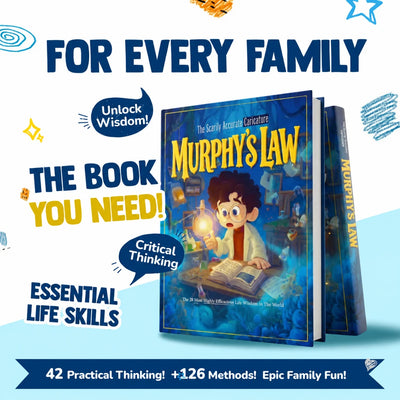
The most practical life wisdom in the world, redrawn as comics a child will pick up on their own. Every parent has watched a child fall apart over a spilled drink, a test that went badly or a plan that did not work out. Written by Doris Walton and illustrated throughout with full-colour caricatures, this book takes the idea behind Murphy's Law — if something can go wrong, it sometimes will — and turns it into 28 life principles a child can understand, laugh at and use. It teaches because it is funny, not in spite of it.
What the book covers
- Murphy's Law — why things go wrong, and why that is completely normal.
- Cause and effect — how one choice leads to the next, shown through everyday situations.
- Procrastination and overthinking — why we put things off, and why too much choice can be worse than too little.
- Human nature — recognising the flaws we all share, including the ones in the mirror.
- Embracing failure and making decisions — how results can surprise us, and how to choose when life does not give a clean answer.
Inside are 28 principles, 42 practical thinking frameworks and 126 real-world methods, each presented as a short illustrated story with a plain explanation and a tip rather than a lecture.
Who it suits
- Ages 6–9 — read together; the caricatures carry the idea before the text does.
- Ages 10–15 — reads independently; the kind of book a child opens for the pictures and finishes for the ideas.
- Parents and grandparents who want to give something that lasts longer than a toy or a gift card.
How families use it
Leave it on the table. Each principle is a self-contained comic story, so there is no chapter to commit to — a child reads one page and then quietly disappears with the book for an hour. It also works as a bedtime read, one principle a night, with "has that ever happened to you?" left open at the end.
Good to know
- Text is in English. Full-colour illustrations throughout.
- The 28 / 42 / 126 counts are how the book is organised, not a reading order — dip in anywhere.
- This is a general-interest children's book. It is not a substitute for advice from a teacher, paediatrician or child psychologist where a specific concern exists.
- Reading level varies from child to child — the ages above are a guide, not a rule.